
Betting Guides
What Does Over 1.5 Goals Mean? How to Understand Football Predictions
Over 1.5 Goals is one of the most popular markets in football betting, yet many bettors, especially beginners, still find it difficult to understand exactly how it works and what determines whether a prediction wins or loses.
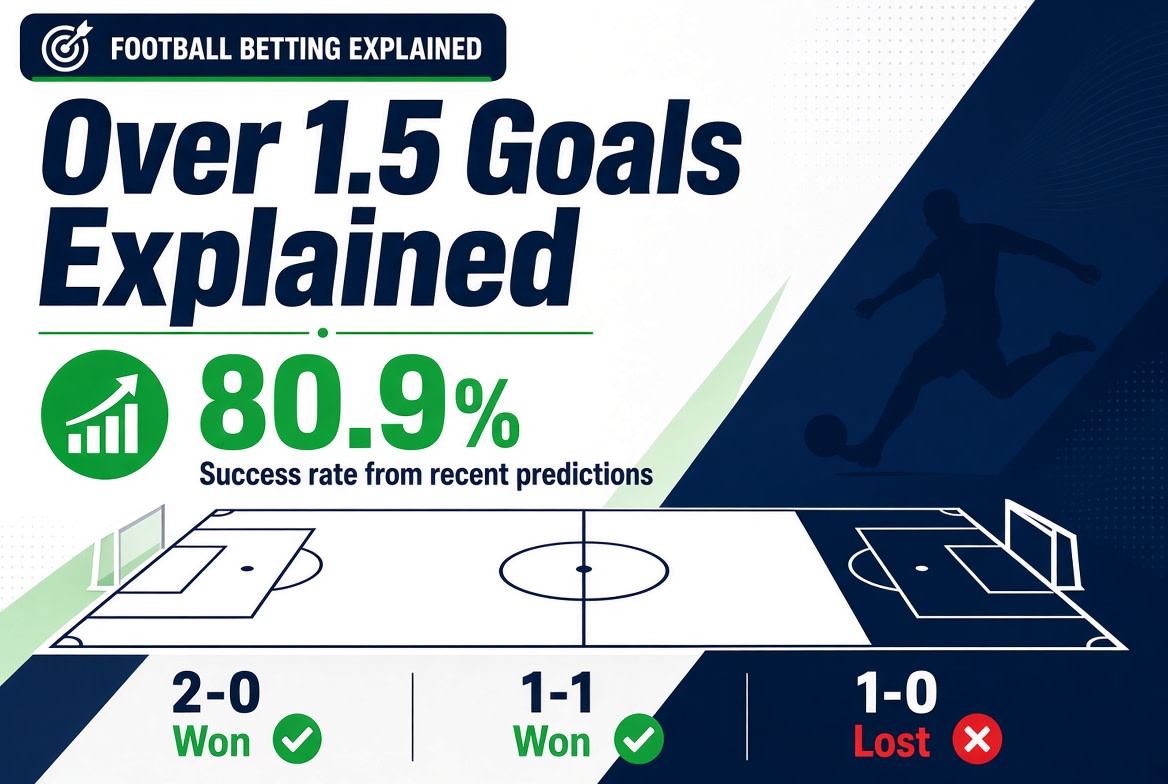
At PredictVilla, we aim to help football bettors understand betting markets and make informed decisions, and help them win more frequently. Over the past two months we have published a total of 6,258 over 1.5 goals prediction and recorded 5,060 wins and 1,198 loses. An incredible 80.9% win rate very few sites can boost of records like that and predictvilla is top of that list.
This article explains Over 1.5 Goals in football predictions, outlines winning scorelines, discusses influencing factors, and offers guidance on identifying matches likely to produce at least two goals.
Whether you are new to football betting or seeking to increase your understanding of the Over 1.5 Goals market, this guide will clarify the market and its associated risks.
What Does Over 1.5 Goals Mean in Football Predictions?
Over 1.5 Goals means either team must score at least two goals in a match for the bet to win.
These goals can be scored by one team or shared between both teams.
For example, if Team A scores two goals and Team B scores none, your Over 1.5 Goals bet is settled as won.
If Team B scores two goals and Team A scores none, your bet is also settled as won.
Similarly, if both teams score one goal each, bringing the total goals to two, your bet wins.
It does not matter which team scores; only the combined total of at least two goals is required.
In standard full-time betting, goals scored during the 90 minutes of regulation time, including stoppage time, count toward the final result.
Goals scored during extra time, typically played in knockout competitions, generally do not count unless specified by the bookmaker.
Examples of Winning and Losing Over 1.5 Goals Bets
The following table shows how Over 1.5 Goals bets are settled based on the final score.
| FULLTIME SCORELINE | TOTAL GOALS SCORED | BE SETTLED AS: |
|---|---|---|
| 2 – 0 | 2 | WON |
| 1 - 1 | 2 | WON |
| 2 - 1 | 3 | WON |
| 1 - 2 | 3 | WON |
| 3 - 0 | 3 | WON |
| 2 - 2 | 4 | WON |
| 0 - 0 | 0 | LOST |
| 1 - 0 | 1 | LOST |
| 0 - 1 | 1 | LOST |
An Over 1.5 Goals prediction wins when the combined total of goals is two or more.
However, if the match ends with fewer than two goals, the prediction loses.
For example, a match ending 1–0 does not qualify as Over 1.5 Goals because only one goal was scored.
Similarly, a 0–0 draw means no goals were scored, resulting in a losing prediction.
How Does Over 1.5 Goals Betting Work?
When you select Over 1.5 Goals on a bookmaker’s platform, you are predicting that the match will produce at least two goals before the end of regulation time, including stoppage time.
Unlike betting on a particular team to win, you do not need to predict the winning team or the exact final score.
Your prediction depends entirely on the total number of goals scored.
For example, consider a hypothetical match between Arsenal and Liverpool.
If Arsenal scores in the 20th minute and Liverpool equalizes in the 65th minute, the match has already produced two goals.
At this point, an Over 1.5 Goals prediction has met its scoring requirement, provided both goals remain officially valid and the market is settled under standard rules.
Even if the match eventually finishes 3–3, your prediction still wins because the total number of goals exceeds 1.5.
However, if Arsenal scores once and the match finishes 1–0, the prediction loses.
This makes Over 1.5 Goals different from markets where bettors must predict a particular match winner.
What Factors Affect Over 1.5 Goals Predictions?
Several factors might determine whether a football match produces at least two goals.
Although statistical analysis can help identify matches with favorable scoring patterns, football remains unpredictable.
An unexpected injury, a red card, a tactical adjustment, or even poor finishing can change the outcome of a match.
Knowing these factors can help bettors evaluate football predictions more carefully.
1. Team Attacking Strength
A team’s attacking strength is an important factor to consider when analyzing Over 1.5 Goals predictions.
Teams that consistently create scoring opportunities may be more likely to score during matches.
However, the number of goals a team scores should not be considered in isolation.
It is also important to examine the quality of chances created, the opposition faced, and whether the team can consistently convert opportunities into goals.
2. Defensive Performance
The defensive performance of both teams can influence the likelihood that a match will produce multiple goals.
Teams that regularly concede goals may create favorable conditions for an Over 1.5 Goals prediction, particularly when facing opponents with strong attacking records.
However, defensive weaknesses alone do not guarantee goals.
A team may struggle defensively but still face an opponent that creates very few scoring opportunities.
For this reason, the attacking and defensive statistics of both teams should be considered together.
3. Injuries and Player Availability
Injuries can greatly affect the outcome of football matches.
For example, an injury to a team’s leading striker may reduce its attacking threat, particularly if the replacement player has a weaker scoring record.
Similarly, injuries to important defenders or a first-choice goalkeeper can affect a team’s defensive organization.
Injuries occurring during a match can also force tactical changes that influence the number of scoring opportunities created.
Before selecting an Over 1.5 Goals prediction, bettors should consider confirmed team news and the availability of important players.
4. Red Cards and Disciplinary Decisions
A red card can change the tactical structure of a football match.
When a team loses a player, it may become more defensive to protect its position.
Alternatively, the opposing team may exploit its numerical advantage to create additional scoring opportunities.
However, a red card does not automatically increase the number of goals scored.
In some matches, the team with fewer players may defend more deeply, reducing the space available to its opponent.
The effect of a red card depends on the match situation, the teams involved, and the tactical decisions made by their managers.
5. Home and Away Performance
Some football teams perform differently depending on whether they are playing at home or away.
A team may score frequently at home but struggle to create chances when playing away from its supporters.
Similarly, another team may concede fewer goals at home than it does in away fixtures.
Examining these differences can provide useful information when evaluating Over 1.5 Goals predictions.
6. Tactical Approach and Playing Style
The tactical approach adopted by both teams can influence the number of scoring opportunities created.
Teams that press aggressively, attack with several players, and play at a high tempo may produce more open matches.
In contrast, teams that prioritize defensive organization and possession control may limit scoring opportunities.
The interaction between the two teams’ playing styles is often more useful than examining either team’s tactics in isolation.
7. Fixture Congestion and Fatigue
Teams playing several matches within a short period may suffer fatigue, particularly when traveling between domestic and international competitions.
Fatigue can affect defensive concentration, attacking movement, and overall match intensity.
Squad rotation could also affect performance when managers rest important players.
These factors should be considered alongside team news and recent results.
How to Analyze Over 1.5 Goals Predictions
Understanding the meaning of Over 1.5 Goals is only the first step.
The next step is learning how to assess whether a particular football match has a reasonable chance of producing at least two goals.
At PredictVilla, we believe that informed predictions should be supported by relevant football statistics rather than assumptions.
Examine Recent Goal-Scoring Records
Start by reviewing how frequently both teams have participated in matches producing at least two goals.
For example, consider a hypothetical team whose last ten matches produced the following results:
| MATCH | FINAL SCORELINE | OVER 1 . 5 GOALS? |
|---|---|---|
| 1 | 2 -1 | YES ✅ |
| 2 | 1 - 1 | YES ✅ |
| 3 | 3 - 0 | YES ✅ |
| 4 | 0 - 0 | NO ❌ |
| 5 | 2 - 2 | YES ✅ |
| 6 | 1 - 0 | NO ❌ |
| 7 | 3 - 1 | YES ✅ |
| 8 | 2 - 3 | YES ✅ |
| 9 | 0 - 2 | YES ✅ |
| 10 | 1 - 2 | YES ✅ |
In this example, eight of the team’s last ten matches produced at least two goals.
The historical Over 1.5 Goals percentage can be calculated as follows:
Over 1.5 Goals Percentage = (Matches with at least two goals ÷ Total matches analysed) × 100
Therefore:
(8 ÷ 10) × 100 = 80%
This means that 80% of the team’s last 10 matches ended with at least 2 goals.
However, this does not mean the team has an 80% probability of producing Over 1.5 Goals in its next match.
Historical statistics describe previous performances. They do not guarantee future results.
Analyze Both Teams, Not Just One
A common mistake is selecting an Over 1.5 Goals prediction based entirely on one team's scoring record.
Football matches involve two teams, and the performance of both sides can influence the final score.
For example, a team that regularly scores multiple goals may struggle against an opponent with a strong defensive record.
Similarly, two teams with modest attacking records may still produce multiple goals if both have defensive weaknesses.
A balanced analysis should consider the attacking and defensive performances of both teams.
Consider Expected Goals (xG)
Expected Goals, commonly referred to as xG, is a statistical measure used to estimate the quality of scoring opportunities created by a team.
Each scoring opportunity is assigned a probability of resulting in a goal based on factors such as shot location, angle, and other information included in the statistical model.
A team with consistently strong xG figures may be creating good scoring opportunities even when its recent results do not reflect that attacking performance.
However, xG is not a guarantee that goals will be scored.
It is one analytical tool that can help bettors understand the quality of chances created during football matches.
Examine Recent Opposition Strength
Not all scoring records carry the same meaning.
A team that scores frequently against weaker opponents may find it more difficult to maintain that record against stronger defensive teams.
When reviewing recent performances, consider the quality of the opposition and the circumstances surrounding those matches.
This can provide a more balanced assessment than simply counting goals scored.
Over 1.5 Goals vs Over 2.5 Goals vs Both Teams to Score
Although these football betting markets are related, they have different winning conditions.
Over 1.5 Goals requires at least two goals in the match.
Over 2.5 Goals requires at least three goals in the match.
Both Teams to Score (BTTS Yes) requires each team to score at least one goal.
The table below illustrates the differences.
Column 1 Column 2 Column 3 Column 4
| FINAL SCORE | OVER 1.5 GOALS | OVER 2.5 GOALS | BTTS YES |
|---|---|---|---|
| 0 - 0 | LOST ❌ | LOST ❌ | LOST ❌ |
| 1 - 0 | LOST ❌ | LOST ❌ | LOST ❌ |
| 1 - 1 | WON ✅ | LOST | WON ✅ |
| 2 - 0 | WON ✅ | LOST ❌ | LOST ❌ |
| 2 - 1 | WON ✅ | WON ✅ | WON ✅ |
| 3 - 0 | WON ✅ | WON ✅ | LOST ❌ |
| 2 - 2 | WON ✅ | WON ✅ | WON ✅ |
Knowing these differences is important because a prediction can win in one market and lose in another.
For example, a 2–0 result qualifies as Over 1.5 Goals but does not qualify as Both Teams to Score.
How to Win Over 1.5 Goals Bets: Probability and Betting Odds
One important aspect of football betting is understanding the relationship between an outcome's probability and the odds offered by bookmakers.
A prediction may have a relatively high probability of winning but still offer poor betting value.
For example, decimal odds of 1.30 imply a break-even probability of approximately 76.9%, before accounting for the bookmaker’s margin.
The calculation is:
Implied Probability = (1 ÷ Decimal Odds) × 100
Therefore:
(1 ÷ 1.30) × 100 = 76.92%
This means a bettor would need to win more than approximately 76.9% of comparable bets at those odds to achieve a positive long-term return, assuming the same stake each time and no other costs.
If a bettor estimates the true probability of an outcome to be 70%, odds of 1.30 would not offer positive expected value under that estimate.
The challenge is that estimating true probabilities accurately is difficult.
Historical goal percentages, team statistics, and football analysis can help inform these estimates, but none can eliminate uncertainty.
The objective should not simply be to identify matches likely to produce two goals, but to assess whether the available odds reasonably reflect the risk involved.
Common Mistakes to Avoid When Betting on Over 1.5 Goals
Many bettors lose money not because they misunderstand the meaning of Over 1.5 Goals, but because they overlook important details when evaluating matches.
Some common mistakes include:
****1. Relying only on recent results: A team’s last few scorelines may not accurately represent its current attacking or defensive strength. ****2. Ignoring opposition quality: Strong scoring performances against weaker teams may not continue against stronger opponents. ****3. Overlooking injuries and team news: The absence of key players can affect a team's performance. ****4. Assuming low odds guarantee success: A low price does not mean a prediction cannot lose. ****5. Combining too many selections: Adding several Over 1.5 Goals predictions to one accumulator increases the number of outcomes that must all occur for the bet to win. 6. Chasing previous losses: Increasing stakes to recover money lost on earlier bets can expose bettors to greater financial risk. ****7. Confusing historical percentages with future probabilities: A team recording Over 1.5 Goals in eight of its last ten matches does not guarantee the same outcome in its next fixture.
Avoiding these mistakes does not guarantee winning bets, but it can help bettors make more informed decisions.
How predictVilla Evaluates Over 1.5 Goals Matches
At PredictVilla, our objective is to provide football predictions and useful match information that help bettors understand the markets they are considering, and give them the best chance at winning more frequently.
An informed Over 1.5 Goals assessment should examine several important factors, including:
- Recent goal-scoring and goals-conceded records.
- Home and away performances.
- Attacking statistics and expected goals.
- Defensive organization and most-recent performances.
- Confirmed injuries, suspensions, and team availability.
- Tactical approaches and match circumstances.
- The relationship between estimated probabilities and bookmaker odds.
No single statistic can determine the outcome of a football match.
For this reason, combining different sources of match information provides a more balanced foundation for evaluating football predictions.
We aim to help readers understand why a particular match may be considered suitable for an Over 1.5 Goals prediction, rather than encouraging them to rely on unsupported claims or guaranteed outcomes.
Readers looking for current match selections can also explore the latest Over 1.5 Goals predictions on PredictVilla.
Frequently Asked Questions About Over 1.5 Goals
What does Over 1.5 Goals mean in football betting?
Over 1.5 Goals means that at least two goals must be scored between both teams during a football match for the prediction to win. Either team can score both goals, or both teams can contribute one goal each.
Can I win Over 1.5 Goals if only one team scores?
Yes. If one team scores two or more goals while the opposing team scores none, the Over 1.5 Goals prediction wins. For example, a match ending 2–0 or 3–0 qualifies as a winning result.
Is Over 1.5 Goals the same as Both Teams to Score?
No. Over 1.5 Goals requires at least two goals in total, regardless of which team scores. Both Teams to Score requires each team to score at least one goal. A 2–0 result wins Over 1.5 Goals but loses BTTS Yes.
Does a 1–1 draw count as Over 1.5 Goals?
Yes. A 1–1 draw produces two goals in total, meaning an Over 1.5 Goals prediction is settled as won.
Does a 1–0 result count as a win for an Over 1.5 Goals bet?
No. A 1–0 result contains only one goal. Since Over 1.5 Goals requires at least two goals, the prediction loses.
Do injury-time goals count for Over 1.5 Goals?
Yes. Goals scored during first-half and second-half stoppage time count toward standard full-time Over 1.5 Goals bets. However, goals scored during extra time generally do not count unless the bookmaker’s market rules state otherwise.
What is the difference between Over 1.5 Goals and Over 2.5 Goals?
Over 1.5 Goals requires at least two goals, while Over 2.5 Goals requires at least three goals. A 1–1 result wins Over 1.5 Goals but loses Over 2.5 Goals.
How can I identify matches likely to produce Over 1.5 Goals?
You can examine both teams’ recent scoring records, goals conceded, attacking statistics, expected goals, injuries, tactical approaches, and home and away performances. These indicators can help assess the likelihood that a match will produce at least two goals, but they cannot guarantee the outcome.
Are Over 1.5 Goals predictions guaranteed to win?
No. Every football prediction carries uncertainty. Even matches involving strong attacking teams can finish 0–0 or 1–0. Statistical analysis can support better decision-making, but it cannot eliminate the possibility of losing.
What happens if a match is abandoned?
Settling an Over 1.5 Goals bet on an abandoned match depends on the bookmaker’s rules and whether the outcome had already been determined. Some bookmakers may settle a bet that has already met its winning condition, while others may apply different rules. Always check the bookmaker’s terms.
Do own goals count toward Over 1.5 Goals?
Yes. Officially awarded own goals generally count toward the total number of goals in standard Over 1.5 Goals markets. For example, if a match finishes 1–1 and one of those goals is an own goal, the Over 1.5 Goals prediction still wins.
Where can I find Over 1.5 Goals predictions today?
You can visit PredictVilla for football predictions and match information. Before placing any bet, review the supporting statistics, available odds, and risks associated with the selection.
Final Thoughts: Knowing Over 1.5 Goals Predictions
Over 1.5 Goals is a straightforward football betting market once you get its winning conditions.
For your prediction to win, the match must produce at least two goals during regulation time, including stoppage time.
It does not matter which team scores the goals or which team eventually wins the match.
However, understanding the meaning of Over 1.5 Goals is different from effectively predicting which matches will produce two or more goals.
Several factors, including injuries, tactics, player performances, defensive organization, and unexpected events during play, impact football matches.
At PredictVilla, we believe that football bettors should have access to clear explanations and useful information that help them make informed decisions.
Our goal is to make football predictions easier to understand while encouraging readers to evaluate every selection carefully.
Explore more football predictions and match analysis at PredictVilla.
Responsible Betting Notice: Football predictions are not guaranteed. Bet only what you can afford to lose, avoid chasing losses, and follow the gambling laws and age restrictions applicable in your location. What Does Over 1.5 Goals Mean? How to Understand Football Predictions.